Friday, July 15, 2016

White Mama

On July 6th, my teenage, African-American son said to his younger brother and sister,
“Police kill black people.”
And these are the stupid, white-mama words that I said.  
“That’s not true.”  
“Don’t teach your brother to be afraid.”
“Don’t contribute to prejudice by stereotyping all police officers.”


Then I went home and saw the news reports and learned that in fact,
it is true,
he and his little brother have every right to be afraid,
and that this stereotyping is founded in reality.  


I wanted to drive back along the route that we had just driven as I soap boxed through issues of prejudice and racism as if I knew a damn thing and find the words that flew from my mouth to his ears, to his heart, and catch them.  Catch them, erase them, swallow them back up, unsay them.  Those devastating, you don’t get it words.  


I don’t get it.  I won’t get it.  I can’t get it.  


Because this thinking, this systemic racism that he lives with and encounters daily but I can only hear about and read about, is foreign to me.  I don’t get it.  I don’t want to believe it is real.  It shocks me and baffles me every time and I sit and say,surely, not and “it can’t be”.  I sit in my naive bubble of white privilege and pretend that it does not exist.  Sitting here in my skin, I have that luxury.  I know quite literally nothing about what it is to be a young black man yet I am charged with raising one and clearly, I don’t know what I’m doing.  I am a naive little white woman skipping around in my pretty privilege.  It’s almost a joke that this is my job- to raise this boy.  And he knows it.  


After the stupid words flew out of my mouth, he had to get away from me.  Of course he did.  I fumbled out the false and impossible words of, “I understand” and then I stupidly said, “...but...” and he graciously replied, “ok”.  He practiced restraint in his response to me.  Just like he knows he has to do and will always have to do to protect himself and to stay alive.  Such control.  He has already learned such control.  Tragically, he gets to practice with me.   


Thursday, August 13, 2015

Hospitality and injustice

When we arrived for lunch, she wasn't home. After taking the path around to the back where her doorway is and finding the place empty, the line of us turned around and headed back to the open space in front of the cluster of homes. The 13 of us stood around awkwardly wondering where our hostess was. Our translator asked the other women nearby if anyone knew her and where she was but the answers he got were short and unhelpful. Aren't you her friends? He asked them. We mused about where she could be, if we were late, how long we should wait but we didn't have to wonder long because soon she appeared. She was in a hurry to greet us all. She greeted many of us with kisses and when she got to me, she grabbed my hand and pulled me to walk with her back to her home. I was so happy to be here again. Last year, my lunch with her was an unforgettable time of friendship and hospitality and today would prove to be no different.

Now we follow the path again and as we enter the doorway we each have to duck down to enter the one-room home. There are no chairs in the room but there is a bed, a mat on the floor and a couple of low plastic crates. As we enter the room one by one, it is apparent that seating will have to be strategic. Let's see, I'll go here and you go there. Our hostess is not concerned, she continues beckoning the line into her home. Oh look, there's a kitten in here too. One of us unknowingly steps on its' tail- howl. And this is how we ended up: Seven of us on her bed. (Muddy shoes? No problem, just climb on!) Three of us in a row on her son's sleeping mat on the floor and two of us on crates on the floor by the cook stove. Our translator squats in the doorway.


As we sit here on this bed, I see my teammate next to me struggling with emotion. He loves this family and especially the seven-year-old, HIV positive, boy who lives here. Two years ago when my friend met Little One it was instant bond and for the first time my teenage friend felt like a responsible dad. 
How can this fatherly instinct produce anything but internal torture to the young man who has to go back to America after two weeks? As we sit here and take in the intensity of the moment, the young man buckles under this family's reality. It's dirty. There are bugs. It's dark. It's small. No bathroom or kitchen or playroom. It can't be true, but it is. This is where his heart-son, Little One, lives. This dark and smelly pathway to his home is where he plays. But now, Little One, climbs up to his favorite lap to play and tears and emotion must be subdued to give him playful moments together. Deep breath, Young Man. Little One gets a hold of my camera and takes photos of everything and everyone, capturing the moments and funny faces from a child's-eye-view. The photo taking session provides the comic relief that we all need.


The food is ready. It's been warming on the fire. She ladles potato stew on top of the enjera bread which is served at every meal and puts it on our laps. There are two or three trays for sharing and we begin to feast. The food is amazing and we pass it from hand to hand, mouth to mouth. We all eat our fill and somehow it keeps coming from the bottomless pot on the fire.

After the meal is over, the coffee ceremony begins. 


She fans the coals which prompts the jebena (traditional coffee pot) to boil. Coffee- roasted, pounded and steeped to perfection, just for us. The tiny cups are passed around, balanced on knees and sipped with appreciation. And now comes sharing time.

Through our talented translator, I thank her for her hospitality and for welcoming me here again. “Last year you welcomed me and my son, Dawit, but this year you welcome me and all of our team to your home. We are very honored to be here in your home.” She thanks and blesses and blesses and thanks. And then she shares more of her life. There is always more than you can see and today I'm shocked at what the “more” is. The story of this woman's rejection and shame runs deep and soaks her story with pain. She was left by her husband because of their difference in beliefs. She follows Jesus and he follows Mohammed. She would not change for him and so he left. After discovering that she and her son were sick with HIV they came to the city for treatment. They came to this area, Kore, to this home, carrying the secret of their illness with them. For a while, things were looking up. She began selling corn on the side of the road, her son started school and she was receiving help from a sponsorship program. But all of this came crashing down when she naively confided her story to a women she thought was a kind friend. This “kind friend” instead made the news public and because she was also the landlord of the area homes, she raised her rent to almost double. She also forbade her use of the community water pump so now she has to go outside to another area to get her daily water supply.

Now our interactions with the local women when we arrived makes more sense. No one would claim to know her. This part of her story surprises me the most. I was under the impression that because this place is known for it's HIV and TB and leprosy that the people here would not turn on each other. I thought that they came to this place because they were shunned and needed safety but now here they are shunning each other. I thought they would hold each other up but instead I found a class system among the outcasts.

As she shares this part of her story her tears begin to fall and so do mine. I'm in the back row on the bed, my legs are asleep, but I have to get to her. I stand up on her bed and climb over my friends. I meet her on the floor by the fire and hug her. We share a tearful embrace. I don't come with the answers and that infuriates me but I can sit with her in her pain. And because that is what God does for us in our pain, I know that that is enough for this moment. I hold her and cry with her and then with our arms about each other I pray with her. Father?! Your daughter! Your treasured, beautiful daughter. After kisses and prayer, the hostess in her commands me back to my place on the bed. Here, a good hostess always makes her guest come in, sit down and eat!

And so more eating is what comes next. She fans the coals again and sets corn over them, darkening each kernel. She turns them and more chatting and questions and laughter fly about the small room. Sometimes a thoughtful silence falls about us all. As they are finished she wraps the hot cobs in husk to protect our hands and passes them around. Everyone has their fill and then some.

Soon it's time to go. We pass around our goodbyes, each one hugging our hostess with thanks, and file back out the way we came in. The daylight outside seems too bright. A teammate lingers back to be the one to walk proudly with her, holding her arm, out into the open; a gesture showing the world that this woman is valuable and safe. 

 As we walk back to the van, the feeling slowly returns to our cramped up legs and rears. She walks us all the way. In the van driving away, we talk benignly about the bug bites we got while were there. I think we do this to distract us from her tears and the monumental injustice that caused them.   

Wednesday, August 12, 2015

at the dump

All week I've been thinking about this place. Something draws me here and as the van drives up closer to the face of the dump and so many children run to greet us, I know what it is- it's them! I can't advocate for people I've never met or share the plight of a people I've never seen. So today I will see this place firsthand. As I climb out of the van, the rest of the team looks solemn. They've done this before. Last week, on a day that my boys and I spent with family, the team came here. When we met up with them later for dinner, their faces held this same expression. A mixture of shock and helplessness. As they shared what they had seen and experienced at the dump and about the people who lived there, my heart joined them in their grief and a wave of sorrow smothered me. They live at the dump. Their homes are plastic and tarp. They live where the sludge collects at the bottom of the mountainous heaps of trash.

I couldn't eat. I spent most of that evening on the floor of a stall in the restaurant bathroom crying out in anger to God. “Why, God? It's not right. It's just not right”.

Now I get out of the van to meet these people for myself. A beautiful elderly woman and her nearly blind daughter and four-year-old granddaughter greet us. This grandmothers' hugs and kisses are so fervent that they hurt my cheeks. Her smile is so broad that it hurts my eyes. It's an oxymoron for her to be smiling here. I half want her to stop- doesn't she see her surroundings? Doesn't she perceive the danger here for her family? But on she smiles with a joy that is either utterly stupid or profoundly supernatural. At this moment, I can't tell which. 

 We balance our way along a one and a half foot wide concrete ledge which any misstep off either side would land us 12 feet down into a green river of sewage and garbage. The four year old granddaughter navigates it with ease. This is her neighborhood.
We continue walking toward her home, following after sure-footed-grandmother in the lead. The path to her home is mud and garbage but mostly smashed empty plastic bottles. With each step, the bottles crush down and the mud seeps up and overtakes my shoe. Now the dump is in my shoe. After a short distance, we take a left off the path and are faced with a steep, rocky, muddy trail down to her home. Find sure footing. Don't slip. And yet grandmother swiftly leads the way with nearly blind daughter and four-year-old granddaughter following. We are soon at the bottom, standing in front of her home. Her makeshift home is leaning awkwardly, evidence that the hillside is slowly giving way under the weight of the daily rain and the trash collected there. Each day during rainy season, water seeps up through the ground of her house making it muddy inside as well as out.

I look back up the path that we have just climbed down. On it's right, held back by a fence made of long wooden poles, is a huge pile of plastics to be recycled. The fence leans heavily against the weight, threatening to overtake the path and the home at the bottom. Mudslide is imminent here.

The daughter whose eyesight fails her stares into a space beyond my eyes. Her body is exposed through the shreds of her dress. Her daughter holds on to grandma's skirt and looks up curiously at the white visitors.

Grandmother tells us about stomach pain and surgeries and about the miraculous provision from the Ethiopian hosts who have brought us here. She tells us how her life is improving. Our translator tells her that all things good are from God. She heartily agrees. When asked permission for a photo, she puffs up and laughs, getting ready to pose.

In spite of these surroundings, this grandmother smiles, motions to the heavens and blesses the Lord.

I know this grandmother is teaching me something but I'm not sure what it is. “Be thankful for what you have?” Too simple. “Real joy comes from knowing God?” Okay, but I know God too and still my joy wanes at trouble. What's the lesson, grandmother? Maybe the lesson is still to be discovered. Maybe I'll find it as I figure out how to respond to what I've seen here today.


As I leave the garbage dump village of Kore this year, I am finding it a strange honor to be bitten by these damned bugs and covered in this parasitic dirt. It's not enough suffering to compare with the suffering of the people here. Some people ask God, 'why them and not me?' But I truly believe our placement on the is earth is some kind of dumb luck. I'm not chosen for privilege while this grandmother is chosen for tragedy. Dumb luck though, doesn't exempt me from knowing the poverty of the world.  It only puts me in a position to change it. I'd like to find out how to change it, please. Someone tell me how and then I'll do it.   

Friday, August 7, 2015

A day with family

The laughter from memories being shared are slowly replacing the tears that used to be shed here; here in this tin and tarp home. Each time we see each other again, our hearts mend a little more.

She said goodbye to her children one sunny day in December almost six years ago. On that day, they all lined up for a photo. The oldest crying and the other two looking around tentatively as they watched the adults and big brother shed their tears. The meaning of all this and what was coming next was something they could only dream of or imagine. But no imagination was big enough to hold all of the upheaval that was to follow. Their dreams were big and fanciful. Their imaginations holding back all sorrow, all pain. They played their way through the next week as only young children can, waiting to fly away to their new home. So much has happened between then and now.

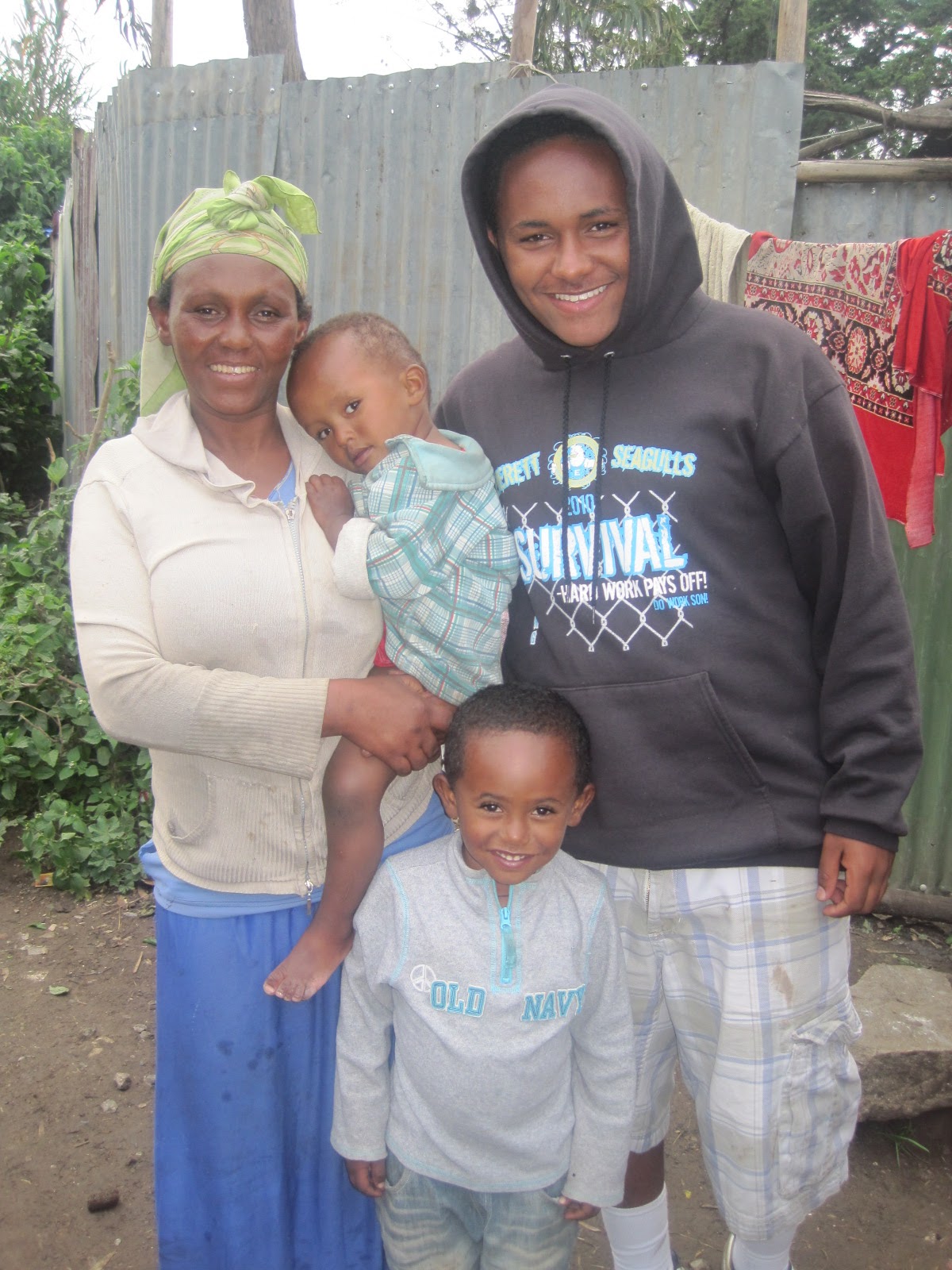
Today, as we pull up in the van and step out onto the muddy street, we know it is our last time to see them this trip. I bring with me, our shared son Dawit, my son Blake, Jason, our pastor and friend, and Girma, our translator and friend. Dawit's mother, Kidist, her new husband, Yetayo, and two small brothers are waiting for us. Their smiles always greet us and we know without question that we are family and that we belong here. Dawit is grabbed and held and kissed with vigor by his mother and I wait my turn for greeting. After greetings are shared, we are swiftly ushered into their home with a familiar “gibu!” meaning “get in!” We pile in and sit along the edge of the bed of the one-room home. When the edge of the bed is full, I slip off my shoes and step up on the bed and sit behind. There is always room for us all.

Now, with traditional Ethiopian hospitality, preparations begin to fill us to overfull with fresh baked enjera, potatoes, cabbage, rice, spinach and bread. Kidist, opens the drawer and takes out some birr and gives it to a child to run to the market for soda. We are soon being offered a variety of sprite, fanta, and coca-cola. Kidist runs to and fro from the outdoor community kitchen to bring more and more food which is piled generously on our plates. We eat and eat until not another hand-full (because here we eat with our hands) can fit into our grateful bellies!

As Kidist takes off again to the community kitchen to make preparations for our bunna (coffee) time, I climb off the bed clumsily to follow her. I am curious about where she goes and how she makes all of this amazing food! The bread is thick and fresh; what kind of oven does she bake it in? I follow her. Partly from curiosity but even more to be with her, to know her better, to understand her life more fully. Instead of allowing me to follow her though, she drops me off at the neighbors house along the way. As soon as I say “hello” to the neighbor outside, I am again commanded with the familiar statement “gibu!” (get in!) and Kidist disappears! I guess my curiosity about the community kitchen will have to wait for another year because as I crouch to enter the neighbors' home, I see that I will have my first round of coffee here.

Four women and two small children are here and I introduce myself all around. A grandmother on the edge of the bed, a young lady crouching by the charcoal stove, one young women hidden in the shadows looking small and somehow separate. At first I don't even see her there.  My greeting surprises her. I immediately wonder about her story, her condition and I wonder especially after she takes no coffee. I ask why and they tell me simply, “she doesn't drink it, she doesn't like it”. To my right, the children eat rice out of a bucket on the floor. The lead woman of the house (I call her that only from observation) sits at the door and directs those around her. She is brought the freshly roasted beans from Kidist's home and begins to grind them with mortar and pestle. Her pestle is a thick, heavy section of re-bar. She pounds and pounds, then stretches her back and coughs. I tell her, “Izosh!”, which is an encouraging word to “be strong!” but then I offer to help. They all laugh! What a thought; a “ferengie” (white person) grinding our coffee for us! They tell me that I am so small and they compare my small hands with the hand of the child in the room. I try not to be offended. Of course, I'm not; I do look small and pathetic next to the woman doing the work.

I look around the one room house. It is so dark. There are plastic bags of belongings strung about along the walls. Some light does make it's way in though. The outside is seen where the wall meets the ceiling; there the mud and stick wall of the home has been weathered away. The rain must come in there. It can't not. And now it's rainy season. I'm not talking about rain that comes in a drizzle or a mist, I'm talking about sheets, torrents, of rain. Rain coming down at all angles, from every direction. Now the plastic bags make sense; anything left uncovered in this home would be ruined from the rain water that surely makes it's way in each time it rains.

As I look around, trying to soak every detail in, I consider so much. I ask myself if I could do this. What would it be like to live among these people? I don't mean just to live here in Ethiopia; here, and yet “ferengie” separate. I don't mean to live a far off in a safe and secure villa with gates and barbed wire separating myself from them at night. I mean to truly live among them. To use the community kitchen (which I still have not seen), to fill my yellow jerry can at the community water pump, to use the community bathroom (can you call a hole in the ground a bathroom? Of course you can.), to bathe my children in a basin outside my tin front door. But all the inconveniences aside- to live among these people. To share their joys and their suffering. To grieve, to laugh, to cough, to drink bunna, to play along side these people. Would that beauty keep me here? Would their story, their reality, crush me? Or could I share in it? Are my shoulders, like my hands, too small for this work?

After I have enjoyed the first cup of coffee, I tell my gracious hosts that I must go back to Kidist's home for the rest of coffee ceremony. They understand and we all kiss cheeks and shoulders goodbye. I also kiss the small one in the corner; again she is surprised. I cross the muddy street and rejoin my family and my friends. We tell more stories, we share more coffee and we also share our thankful hearts. We are thankful for each other and for the unique family we have together and for the beautiful part we each are in each others life. After Blake shares his gratitude, Kidist tells him such an unforgettable thing, “Even though you aren't from my body, you are like my son and I love you.” I marvel at the statement thinking, yes, just like I do for your birth children! I tell her, “We are a big family now; two mothers, seven children”. We both laugh.


When it is time to say goodbye, we take more photos. They will remind us all year of our time together- until we meet again next year. The last hug between mother and son brings the reality of this moment to it's tragic head. How can this be the story? So much healing but the wound will never be gone. To ignore it would be dishonest. Her tears encourage mine and as we load into the van, I kiss my hand and wave it to her. The whole community waves us off. I keep taking him away.

Monday, April 20, 2015

self-preservation


Between posts of sleeping babies and chihuahua videos, I see this. This. It seems impossible to carry on but also completely easy. I feel compassion and heartache as I read the article and see the pictures, but as soon as I look up from my phone, it's gone. Like it isn't there. Like it never happened. Is that normal? Some kind of self-preservation? Well, I don't want to be self-preserved. Real lives ended in forceful, brutal ways. Heads severed from bodies, yet here I sit with my head firmly attached; across the world- my neck is in tact. All around me, children's shouts of excitement echo off the walls of this aquatic center where I now mourn. The kids swim, slide, splash, dive. They are rightly oblivious to the crazy sickness of hatred and pride which clambers to strangle out freedom. Devotion to the God of peace ended the lives of these Ethiopian men on the sunny beaches of Libya. The contrast between the beauty-beach and the ugly that occurred there is deafening and odd. My swimming-pool life contrasts their martyred lives in the same odd way. I feel silent, helpless, supremely lucky and unfairly privileged.

Monday, July 7, 2014

Goodbye Again

The line taxi is full of people and ready to pull away but the hugs aren't finished. How can she let go again? It hurts a thousand times less this time but still, it hurts; like pressing on an old wound. 

Two mom's crying.

In urgency, she hugs hard and looks hard, memorizing his face. We are too soon pulled away and ushered onto the crowded van.  She stands on the curb waving and crying. I stick my white hand out the window and wave. Panic for the finality of this moment overtakes me- “Wave goodbye to your mom” I command. He turns and waves through the dusty window and I hope she sees him.

“Why did you cry, Mom?” he asks me on our walk from the taxi stop to the house where we are staying. How can I explain why this hurts me too?
“Because I can't imagine having to say goodbye to my child again.”


I also cry because I know that I am the one that takes him away. I am the priveleged one that gets to take him home and watch him grow.  

Sunday, July 6, 2014

Reunited

“Are you Dawit, Kidist's son?” We are still around the corner and a ways up the road from their home. I nod and the inquirer runs on ahead to spread the word, “Dawit is home”. We turn the corner at the big Orthodox Church called Gabrielle. The church where this man-sized boy used to hold out his hand for birr to be fed by when he was small. As we round the corner people start coming from all directions. Smiling, hugging, laughing people. People carrying on in Amharic, embracing him and looking into his stunned eyes for recognition. 'Does he remember them?' and 'Wow, how he's grown!'

He is passed through several unfamiliar hugs on his way to the one he is waiting for- the one that he came all these miles for.
“I'm really shaky” he says to me.
He does look unsteady. As we draw nearer to the small dwelling that used to be his home, we stop for a brief second.
“You ready?” I ask.
“Yeah.”
He leads the way for the last few meters and then suddenly the moment is upon him. With arms outstretched she runs to him and throws them around her son. She buries her head in his shoulder crying, then crosses to the other shoulder and embraces again.  And then back again. She let's go for a moment to take him in. She can't believe the truth in front of her. She embraces him again. This is what he came here for. This is what she has dreamed of.


In this moment, the beautiful nature of God is plain. To reconcile- to mend the broken hearted, to make broken things whole again. This is the mysterious and perfect work He accomplished on the cross. Through his one act of selfless love, the sacrifice of His very life, He made a way out of the brokenness of this world; out of the pain and hurt and into a life of wholeness. Here, now, these lives are being made whole again, the empty spaces are being filled.  

His kingdom come.

We walk together to the house and step across the threshold. We all pile in together maneuvering around one another for a place to settle. Dawit, myself and our translator sit in a row along the edge of the bed. Kidist takes the place on a low crate in front of our dangling legs. Yetayo (her husband) takes a seat on a yellow jerry can beside the door. Faces crowd around the doorway- smiling, beaming faces, here to see the news- in the flesh. Dawit's half-brother, 3 year old Yonas, has been spreading the news around the neighborhood since yesterday, “My brother is coming!” But when Dawit is really here, Yonas makes himself scarce and is afraid to come close. People sit around outside the door. Someone puts on music. It's a party; a celebration!

Dawit looks around his childhood home in disbelief then turns to me, “Did this place shrink? It feels like they cut it in half!” His question is so genuine that the translator asks if the one room house had undergone any size reduction! They smile and reassure Dawit that it's the same as it has always been. It is only perspectives that have changed.

So many people come calling as we sit there! They come to the door and lean across the fire where Kidist is roasting the coffee beans for ceremony. They reach to Dawit to shake his hand and they congratulate Kidist on this momentous day. Each guest wants to know if Dawit remembers them and then they tell how close they used to be. “I was your childhood friend”, “I was your neighbor who cared for you”, “I tried to visit you in the orphanage but they wouldn't let me in”.

They all marvel that he can not longer speak his childhood language. I explain to them about the transition to America and how the adopted child's brain is bombarded with so much new information- new language, school, food, family and culture that it is often impossible to retain the past. They all nod in agreement and understanding. Dawit's lack of communication doesn't bother them a bit. They continue to beam and cluck their tongues in amazement. Many run home to get old photos they have of Dawit, Dagmawit (Josie) and Robel when they were small and still beloved members of their community. Photos of birthday parties and gatherings when a tiny Dawit held on to a tinier Robel and Josie is embraced by childhood friends. Depictions of children who knew nothing of the upheaval and heartache that lay ahead of them.

During coffee ceremony Dawit reads the letters from his siblings through our translator updating their mama on their foreign lives in the United States. Lives of learning to read, loving a pet dog, playing sports. She listens and smiles and stirs the blackening beans.

She thanks and blesses and thanks again for bringing Dawit back to see the family. I tell her, “God's intention for family is not to sever the bonds and send children away simply for lack of food. When you gave up your children in order to save them, there was a breaking. Dawit comes back today so that you and he can both heal. We do it for healing.” She nods emphatically, seeing him is healing her pain.

She tells us that giving up her three was the hardest thing she ever had to do. She was sick over it. Her body responded with high blood pressure and anxiety. While they were at the orphanage waiting for a family to adopt them, she wanted so badly to get them back. She went to see them and asked Dawit if he wanted to come home. Through tears he told her, “Mom, it will be better for you without having to take care of us.” And so, she left them there with the hopes of a better life for them and survival for her.

During this time, she shares a dream she once had: In her dream she asked Dawit,
“Dawit, will you forget me?”
“Mom, I will not forget you.” He answered.
“Dawit, will you ever forget me?”
“No Mom, I will never forget you.”
Then she woke up crying.


Our time together ends sweetly, with promises of coming back tomorrow to visit yet more family in a neighboring area. So many smiles, so much relief; like a great weight has been lifted.